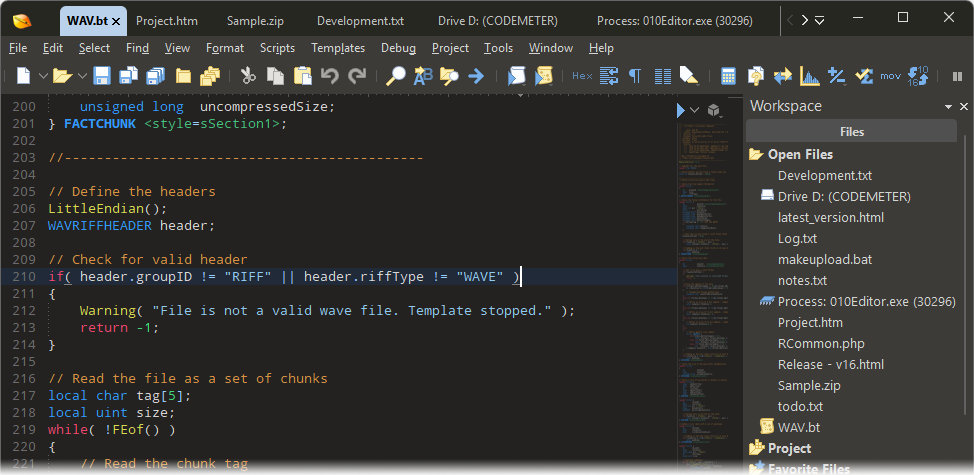
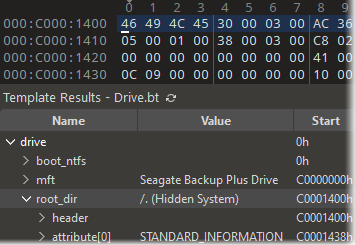
Features real-time syntax parsing using Tree-sitter.
Edit text files, XML, HTML, Unicode and UTF-8 files, C/C++ source code, PHP, etc.
Unlimited undo and powerful editing and scripting tools.
Huge file support (50 GB+) and Column mode editing.
010 Editor
World's Best Hex Editor
Unequalled binary editing performance for files of any size.
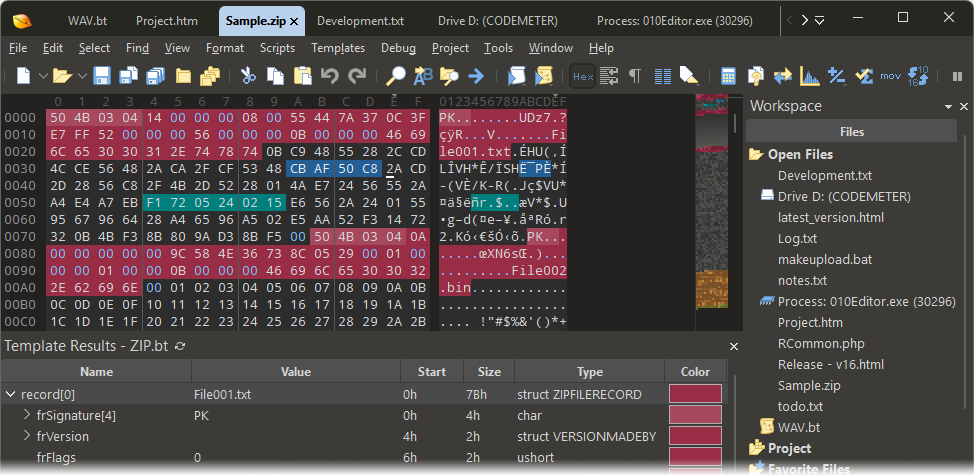
Use powerful Binary Templates technology to understand binary data and
edit 300+ formats.
Find and fix problems with hard drives, memory keys, flash drives, CD-ROMs,
processes, etc.
Digital forensics, reverse engineering and data recovery.
Reverse Engineering
Binary format analysis.
Disassembly of X86, ARM, MIPS, PowerPC, SPARC, SystemZ and XCore.
Interpret binary data in many different formats.
Forensic Analysis
Digital forensics.
Malware analysis.
Powerful search tools and visualizations.
Analyze memory and processes.
Data Recovery
Low-level hard drive editor.
View NTFS, FAT16, FAT32, exFAT, and HFS drives.
MBR and EFI partitions.
View directories, file blocks and slack space.
The increasing reliance on algorithms and automation in various aspects of our lives has led to a growing concern about the potential for algorithmic sabotage. Algorithmic sabotage work refers to the intentional design or manipulation of algorithms to cause harm, disruption, or subversion of systems, processes, or outcomes. This paper explores the concept of algorithmic sabotage work, its types, methods, and implications. We discuss the motivations behind algorithmic sabotage, the challenges in detecting and preventing such acts, and the potential consequences for individuals, organizations, and society.
Algorithmic sabotage work is a growing concern, with significant implications for individuals, organizations, and society. As algorithms become increasingly pervasive, it is essential to develop methods and techniques for detecting and preventing algorithmic sabotage. This requires a multidisciplinary approach, involving expertise in computer science, mathematics, sociology, and law. By understanding the concept, types, and methods of algorithmic sabotage, we can better mitigate the risks and consequences of these malicious acts.
Algorithms are ubiquitous in modern life, driving decision-making processes in areas such as finance, healthcare, transportation, and social media. While algorithms have the potential to improve efficiency, accuracy, and productivity, they also carry the risk of being manipulated or designed to cause harm. Algorithmic sabotage work is a growing concern, as it can have significant consequences for individuals, organizations, and society as a whole.
Analysis Tools - Drill into your Data
A number of sophisticated tools are included with 010 Editor for analyzing and editing binary files:
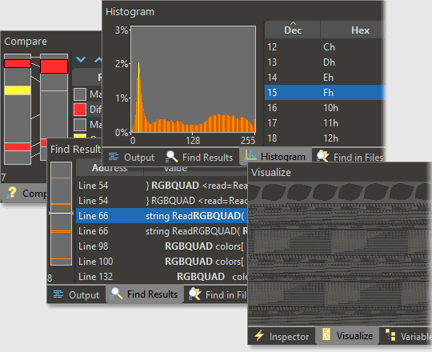
Full Find, Replace, Find in Files, and Replace in Files functionality for many different data types.
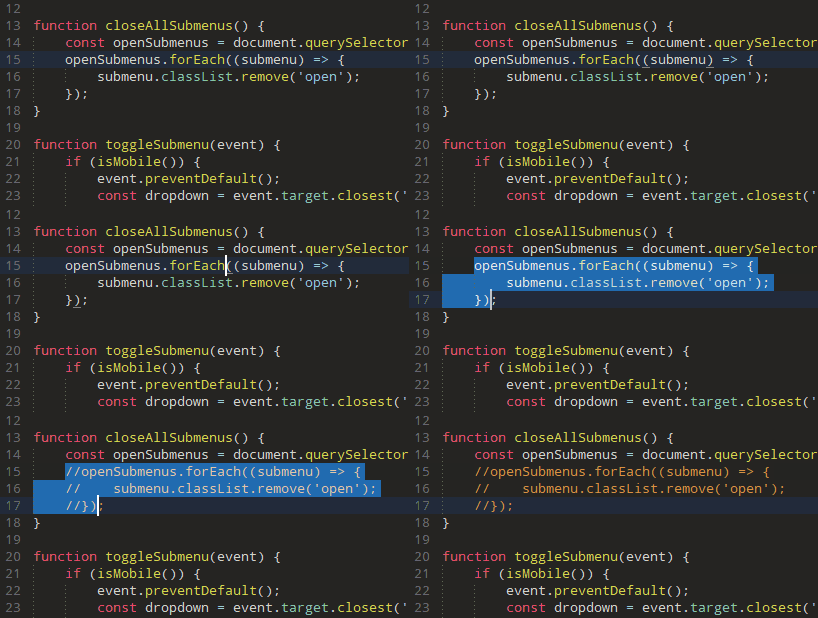
Powerful Binary Comparison tool for analyzing byte-by-byte differences between two files.
Visualize data with the Mini Map or the Visualize tab.
Computes Check Sum/Hash Algorithms including CRC-16, CRC-32, Adler32, MD2, MD4, MD5, RIPEMD160, SHA-1, SHA-256, TIGER, etc.
Disassembler for X86, ARM, MIPS, PowerPC, SPARC, SystemZ and XCore.
Use the Histogram tool to count and visualize byte occurrences.
Scripting - Automate your Editing
Simple or complex editing operations can be automated using a syntax similar to C/C++.
Features over 350 different functions for operating on data.
Integrated with Binary Templates to intuitively edit files. Simply assign to variables defined in a Binary Template to modify a file.
Scripts may be shared and a list of scripts for download is available in our Script Archive.
Run scripts from the command line with no user interface for batch processing.
Download a free 30-day trial for Windows 11/10, macOS, or Linux. Try 010 Editor and
we think you'll agree that 010 Editor is the most powerful of all hex editors available today.
The increasing reliance on algorithms and automation in various aspects of our lives has led to a growing concern about the potential for algorithmic sabotage. Algorithmic sabotage work refers to the intentional design or manipulation of algorithms to cause harm, disruption, or subversion of systems, processes, or outcomes. This paper explores the concept of algorithmic sabotage work, its types, methods, and implications. We discuss the motivations behind algorithmic sabotage, the challenges in detecting and preventing such acts, and the potential consequences for individuals, organizations, and society.
Algorithmic sabotage work is a growing concern, with significant implications for individuals, organizations, and society. As algorithms become increasingly pervasive, it is essential to develop methods and techniques for detecting and preventing algorithmic sabotage. This requires a multidisciplinary approach, involving expertise in computer science, mathematics, sociology, and law. By understanding the concept, types, and methods of algorithmic sabotage, we can better mitigate the risks and consequences of these malicious acts. algorithmic sabotage work
Algorithms are ubiquitous in modern life, driving decision-making processes in areas such as finance, healthcare, transportation, and social media. While algorithms have the potential to improve efficiency, accuracy, and productivity, they also carry the risk of being manipulated or designed to cause harm. Algorithmic sabotage work is a growing concern, as it can have significant consequences for individuals, organizations, and society as a whole. The increasing reliance on algorithms and automation in