Secrets Of Mosfet Cross Reference and Replacement Guide
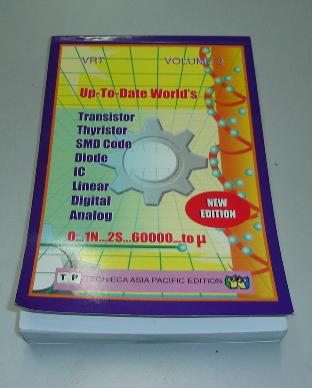
A Semiconductor Replacement Guide Searching for the right mosfet cross reference or datasheet, one has to look for a semiconductor transistor replacement data book and not the Philip ECG master replacement guide. Almost all the transistor replacement book will published out the specification of a particular components such as type of component it belong whether it is a fet, scr, bipolar transistor, horizontal output transistor and also the voltage, ampere, wattage, ohm, frequency and suggested substitution part number.
From my experienced, the substitution part number that was recommended by the data book is not always 100 % match. If you have the time, I would like to suggest to you that, find the right part number by yourself rather than depending on the transistor data book.
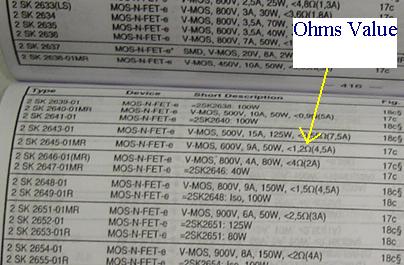
It is the same when you look for horizontal output transistor (HOT) specification which doesn't mean that the bigger specification, the better the substitution part number is. In searching for Mosfet cross reference, you have to look at the ohms value which is provided by the transistor data book besides the specification of voltage, ampere and the wattage. The replacement, besides the same or higher in voltage, ampere and wattage, one should also consider the ohms value. The ohms value has to be as close as possible.
Arrow is showing the mosfet ohms value in a transistor substituion book
If the original fet part number is 1 ohm then a good replacement mosfet must have the ohm values between of 0.5 to 1.5 ohm. Do not substitute it with a too high or too low ohms value as this will make the mosfet run warmer and eventually blow the mosfet itself. Even though you can get a replacement with a higher voltage, ampere and wattage, if the ohms value is too low or too high, the mosfet will still burnt after on for quite a while.
It runs well for sometimes before it breakdown again. After two weeks the customer brought back the printer with the same complaint which is no power. Upon checking the power side I found the same mosfet gave up again. Substituting with another mosfet part number that have a similar specification especially the ohms value solved the printer no power symptom.
Specification with larger voltage, ampere and wattage don’t guarantee that the replacement mosfet will work. So, taking the mosfet ohms value into consideration, you will have a higher chances to repaired the equipment and sometimes the replacement mosfet will also last longer.
|
|
Chennai Express Tamilyogi Direct
Tamilyogi — the word arrives like a local myth given a modern map. It conjures a digital crossroads where cinephiles and couch travelers gather to binge, debate, and remake memory. Inside the train’s portable universe, it’s the shared screen at the end of a compartment where someone plays a beloved Kollywood film on a tablet; the plot elicits laughter and gasps, and strangers join in, syncing applause like an impromptu chorus. The film frames are reflected in window glass, layering the reel’s drama over rivers and glimpses of roadside temples. For many passengers, a Tamilyogi moment is a bridge: it fills hours with music, with MGR-era idealism, with contemporary masala and lyric—uniting generations across creaking seats.
Onboard, the carriage breathed with life. A vendor balanced a tray of steaming idli and sambar, the steam rising and curling into conversations. Students hunched over battered laptops and glossy paperback novels; a grandmother in a faded cotton sari smoothed her hair with fingers that held generations of stories; two teenagers traded headphones and shy smiles, the kind of quiet intimacy that belongs to long rides. The rhythmic clack of tracks became a Cajun for the mind — hypnotic, steady, insistently forward. Chennai Express Tamilyogi
A sultry monsoon evening draped Chennai in its usual honeyed haze. Neon signs flickered like impatient fireflies along the Marina Road; jasmine and auto-exhaust braided in the warm air. From the station platform a train emerged like a promise — chrome ribs catching the orange of sodium lamps, windows glowing with small, private worlds. This was the Chennai Express: a ribbon of motion that stitched the city to its hinterlands, to temples that hummed with evening bells and to fishing villages where boats returned slick with silver. Tamilyogi — the word arrives like a local
Through the window: coconut palms leaning like courteous hosts; the occasional temple tower puncturing the skyline, its stucco deities soaked in soft lamp light; fields where sugarcane and paddy rippled, and small towns where laundry lines created flags of daily life. The cityscape dissolved into lanes of rickety vendors selling steaming murukku, jasmine garlands, and bright plastic toys that clacked when children ran. Every station stop was a miniature theatre: porters hoisted khaki trunks, chai-wallahs executed choreographed rounds, and the tannoy announcer’s voice broke through in crisp Tamil-scented cadence. The film frames are reflected in window glass,
Copyright@ 2006-2014-www.ElectronicRepairGuide.com All Rights Reserved