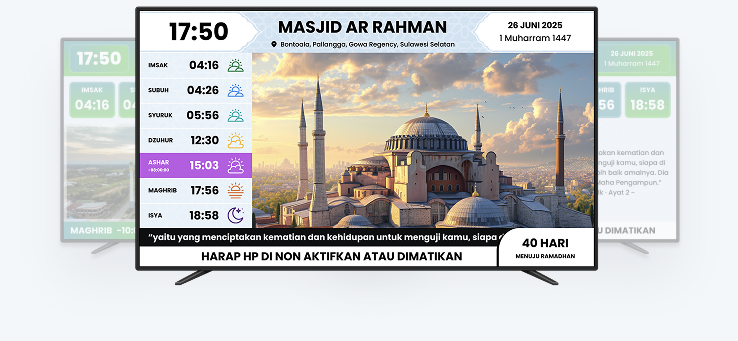
Aplikasi jam digital terbaik untuk masjid, menampilkan jadwal sholat otomatis dan akurat sesuai
waktu resmi Kementerian Agama, dilengkapi fitur pengingat adzan dan iqomah serta desain tampilan
yang elegan.
LIMA WAKTU adalah inovasi teknologi masjid modern yang mengubah jam
digital biasa menjadi TV digital interaktif berbasis aplikasi. Tidak hanya
menampilkan jadwal sholat seperti jam digital konvensional, LIMA
WAKTU memudahkan pengelolaan informasi masjid secara otomatis dan fleksibel, dengan
visual yang menarik dan interaktif.
Berbeda dengan jam digital tradisional yang terbatas pada penunjuk waktu, LIMA WAKTU menawarkan
fitur lengkap, mulai dari jadwal sholat otomatis, mode iqamah, pengumuman masjid,
hingga media dakwah inspiratif. Selain memudahkan pengelolaan, LIMA WAKTU juga mempercantik tampilan
ruang utama masjid, sekaligus menambah nilai dakwah bagi jamaah.
Ratiborus Kms Tools 18.10.2023 - | -appdoze-
Beyond direct malware risks, activation tools interfere with update telemetry and licensing checks that are part of a product’s security lifecycle. Blocking updates, disabling telemetry, or otherwise tampering with built-in mechanisms can leave systems unpatched and exposed to exploitation. For organizations that permit or tacitly endorse such tools on employee machines, the corporate attack surface expands unpredictably.
Technical polish, familiar risks -AppDoze- continues Ratiborus’s pattern of producing compact, single-executable tools that are easy to run and relatively friendly to non-experts. The package typically bundles lightweight GUI wrappers, multiple activation methods, and cleanup/restore functions. For users who prioritize convenience, that polish is seductive: a single click that promises to restore full functionality to Windows or Office is a powerful lure. Ratiborus KMS Tools 18.10.2023 - -AppDoze-
The policy and response landscape Software vendors and platform maintainers have responded through a combination of technical measures, policy enforcement, and education. Microsoft and others increasingly embed robust online activation, device-based entitlements, and cloud-managed licensing to reduce the effectiveness of offline workarounds. At the same time, enterprises have tools for detection and remediation to limit unauthorized modifications. Beyond direct malware risks, activation tools interfere with
Ratiborus KMS Tools has long occupied a controversial niche: a set of utilities that promise to activate Windows and Office products outside official channels. The October 18, 2023 release, labelled -AppDoze-, is another chapter in that uneasy story. This editorial examines what -AppDoze- represents technically, legally, and ethically, and why its existence matters beyond the small communities that use it. The policy and response landscape Software vendors and
But technical polish masks real risks. Tools that manipulate system licensing often require elevated privileges, modify system files, or install services and scheduled tasks. That provides multiple attack surfaces: mistakes, incompatibilities, or malicious tampering can break system stability, corrupt updates, or open persistent backdoors. The temptation to “just try it” runs up against the reality that these tools operate at the heart of the OS, and errors there are costly.
Public policy and law enforcement play roles too: takedowns, legal action against distributors, and outreach campaigns aim to reduce distribution. These measures have impact, but they are reactive; the root drivers — affordability, access, and user knowledge — often remain unaddressed. That gap helps maintain demand and fuels a persistent underground ecosystem.
Security and supply-chain concerns The broader security implications are significant. Tools like -AppDoze- circulate in community forums, file-sharing sites, and social channels where verification is difficult. Even a well-intentioned original author can see their tools repackaged with malware, trojans, or data-exfiltration logic. Users who download an activation utility from a third-party mirror have no reliable way to confirm its integrity. This is not theoretical: the security community has repeatedly documented malicious variants of popular “utility” tools.